

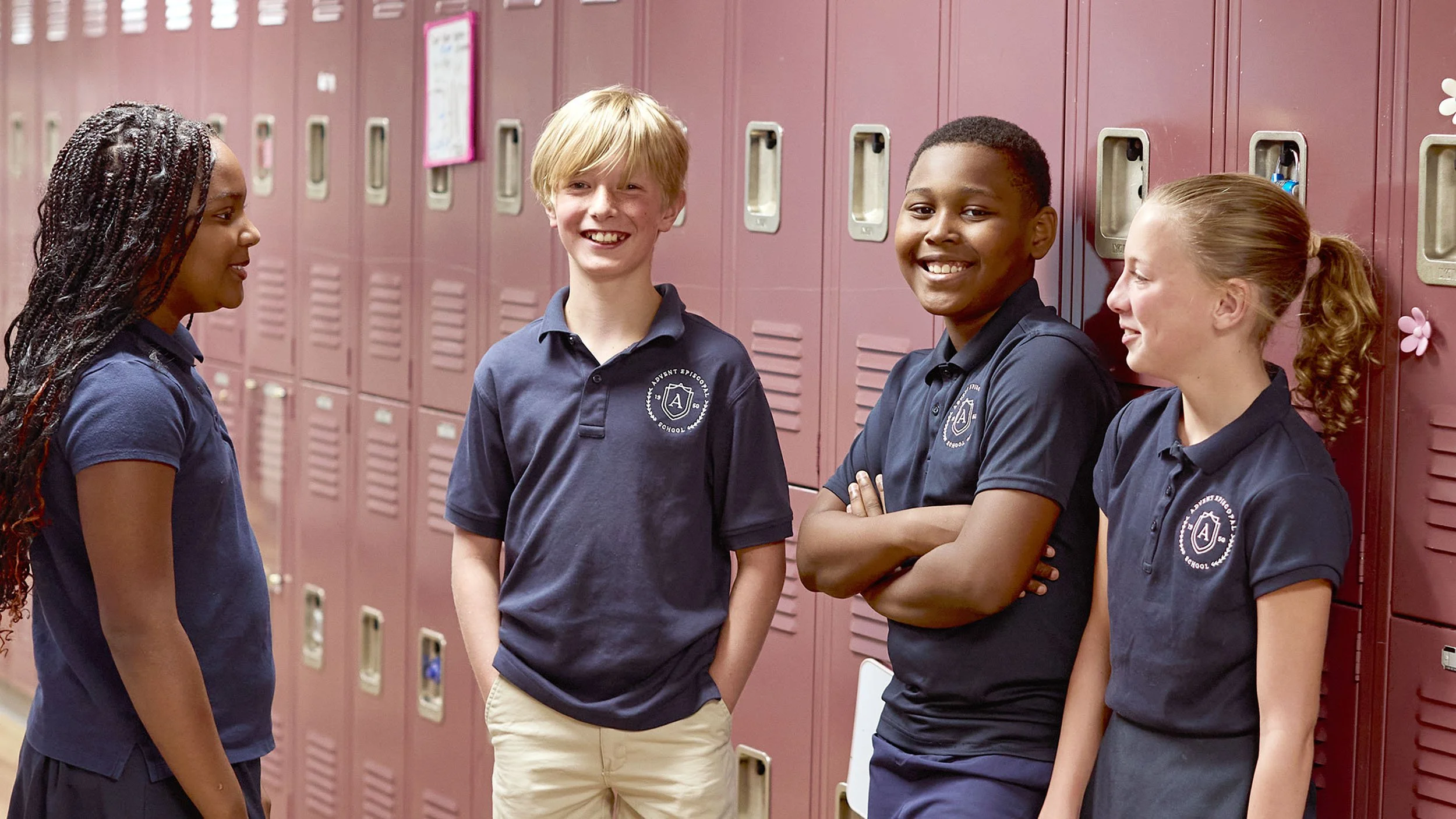
MIDDLE school
Middle School Students Prepare for Success Beyond the Classroom.
6th, 7th, & 8th Grade
Our Middle School is the culminating experience of Advent's academic curriculum. Expanding on the recurring themes of community, culture, confidence, and compassion from earlier curriculums, Upper School students grow in their critical thinking, creativity, leadership ability, and independence as they prepare for high school, college, and beyond.
Our Curriculum
Sixth Grade
Our 6th graders are increasingly social, taking responsibility for their own learning, and have an analytical awareness of themselves and the world.
-
Sixth grade English Language Arts engages students with literature that connect students with the themes also studied in Social Studies - place and culture throughout the world. Through examining their own lives and the lives of their characters, they will learn to see how their own environment, culture, and relationships have shaped who they are. Writing will include descriptive writing, personal narratives, poetry, and a literary analysis of a Shakespeare play. Anchor texts each year often include the play The Diary of Anne Frank, and Julius Caesar.
-
In sixth-grade mathematics, students build a strong foundation for algebraic thinking while expanding their understanding of rational numbers, proportional reasoning, and mathematical relationships. They learn to represent and solve real-world problems using expressions, equations, inequalities, ratios, rates, fractions, decimals, and percents. Students analyze data, interpret graphs, and use probability to make predictions and draw conclusions. Through the study of geometry, they apply formulas to investigate area, surface area, and volume, developing problem-solving skills and seeing how mathematics connects to everyday life, design, and decision-making.
-
Sixth Grade Earth Science explores Earth’s structure, resources, and dynamic systems. Students study minerals, plate tectonics, oceans, and biomes while examining human impact, planetary relationships, and space exploration to understand our planet’s place and processes within the solar system.
-
Sixth Grade World Geography examines human-environment interaction, cultural diversity, and global connections. Students explore how geography shapes economy and culture, migration and population growth, the concept of place, and global issues, fostering understanding of responsible global citizenship.
-
In this course students will build on foundational skills and vocabulary learned in Pre-K-5th grade to gain a deeper knowledge of French language and culture. Beginning grammar concepts are introduced, such as the verbs avoir and être, and well as an introduction to conjugating -ER verbs. Students learn about topics such as talking about their daily routines, describing their families, Francophone Africa, giving directions around a city, and so much more. Major projects include creating and presenting a character family tree, the francophone countries projects, creating and describing a map, and designing a French restaurant or food truck.
-
Sixth grade students further analyze music in terms of forms and application of concepts and terms learned throughout their studies so far. They also apply ideas of expression and musical intent to their studies of the Baroque period. Students also study the elements of jazz music and the importance of jazz in the history of both Alabama and the United States as a whole. As a part of this unit, they visit the Carver Jazz Hall of Fame, complete a research project on a famous Alabama jazz musician, and work together to perform a jazz piece for the school.
-
Sixth grade students continue their exploration of the elements and principles of art. In these art projects the teacher encourages more personal choice and self direction after introducing and modeling a technique or example. Students continue to use a sketchbook in art class to take notes, develop ideas and document their process, and practice their drawing skills.
-
In our sixth grade religion course, students focus on the study of Christianity within the larger scope of world religions.
Seventh Grade
7th graders are invested in intellectual and creative pursuits, have a high interest in the world and social events, and are developing their own set of ideals and role models.
-
Seventh grade English Language Arts engages students with a wide range of literature where students explore plot development, conflict, and resolution in ancient and modern texts. Students will explore more formal modes of writing through literary analysis, sonnets, and odes, as well as more informal modes, such as letter writing and creative storytelling. In addition to reading a Shakespearean classic, anchor texts each year often include Of Mice and Men by John Steinbeck and The Outsiders by S.E. Hinton.
-
Pre-Algebra is a bridge between arithmetic and high school mathematics, designed to strengthen foundational skills while introducing students to algebraic thinking. Students deepen their understanding of numbers, operations, ratios, and proportional reasoning, and begin working with variables, expressions, and simple equations. Emphasis is placed on recognizing patterns, making sense of mathematical relationships, and explaining reasoning clearly. Throughout the course, students develop fluency with the tools and language of algebra, build confidence in problem solving, and learn strategies for tackling multi-step problems. By the end of Pre-Algebra, students are well prepared to transition into Algebra 1 with the skills, habits, and mindset needed for success in more advanced mathematics.
-
Seventh Grade Life Science examines cells as the basic units of life, genetics, and heredity. Students explore DNA, classification, body systems, and diverse life forms through labs and dissections, discovering how organisms function, interact, and sustain life on Earth.
-
Seventh Grade Western Civilization: Greece to World War II explores the rise and fall of civilizations, the influence of religion and belief systems, the power of ideas through innovation and cultural exchange, and the impact of war, conquest, and shifting power on societies.
-
In 7th grade French, students build upon their foundational language skills by developing greater confidence in speaking, listening, reading, and writing in French. Through engaging thematic units, students learn to describe themselves and others, discuss hobbies and daily routines, express opinions, order food, shop, talk about travel and past experiences, and communicate in a variety of real-world situations. Students explore the cultures of the French-speaking world through projects, music, and authentic experiences, including French songs for Lessons & Carols and opportunities to participate in French Club and the Alabama French Convention.
-
Seventh grade students continue to expand on chordal building and analyzing, identifying and composing basic chord movement and cadences using the rules of tonal harmony. They also begin to learn about the Classical era of music, expanding on the forms of the Baroque period into those of the Classical period. Students can play all basic notes on the recorder and some sharps and flats. They can build and analyze basic chords and their movement. They can sight read age-appropriate music (both recorder and voice). They can explain expression and intent they hear in Classical era music examples.
-
Seventh grade students are ready to work independently in art and complete self directed projects for most of their school year. Students review their knowledge of the elements and principles of art and explore personal themes as well as stylistic elements of contemporary artists and artists from historical periods.
-
Our seventh grade religion course focuses on the traditions of the Episcopal faith.
Eighth Grade
Our 8th graders are preparing to step into the next stage of life with critical and independent thinking.
-
Through a wide range of texts, eighth grade English Language Arts students learn to understand the context, author’s purpose, audience, and tone of writing. In addition to reading Greek and Shakespearean classics, the reading in this class will explore the dueling concepts of insiders & outsiders, oppression & courage, and individual & cultural identity. Supplementing these novels, students will also explore the rhetoric of significant speeches of overlapping Social Studies units. Anchor texts each year often include To Kill A Mockingbird by Harper Lee and The Book Thief by Markus Zusak.
-
Algebra 1 is a foundational high school mathematics course designed to build the skills, understanding, and confidence students need for future study in advanced math, science, and real-world problem solving. Throughout the year, students will learn to analyze relationships, model situations using algebraic expressions and equations, interpret graphs, and communicate their reasoning with clarity and precision. Algebra serves as the gateway to higher-level mathematics, including Geometry, Algebra 2, Precalculus, and beyond. It also supports critical thinking in subjects like science, engineering, economics, and computer programming. Most importantly, Algebra 1 helps students develop logical reasoning and problem-solving habits that extend far beyond the classroom.
-
Eighth Grade Physical Science explores the nature and behavior of matter, atomic structure, and chemical reactions. Students investigate the laws of motion, conservation of mass, and properties of elements and compounds through experiments that build understanding of the fundamental principles governing the physical world.
-
Eighth Grade Modern U.S. History explores democracy and the struggle for representation, territorial expansion and its consequences, civil liberties versus government power, the fight for equality and civil rights, and the social impact of war, providing insight into America’s evolving identity.
-
As a continuation of 7th grade French, 8th grade French challenges students to communicate with greater fluency, accuracy, and confidence while exploring more complex ideas and authentic cultural topics. Students compare the past and present, discuss social issues and media, tell and interpret stories, and imagine the future through conversations about innovation and possibility. Through engaging projects, students create advertisements, record suspenseful stories, and design imaginative solutions to real-world and fictional challenges. Special experiences, including Lessons & Carols and the Alabama French Convention, provide opportunities for performance, collaboration, and meaningful communication beyond the classroom.
-
In 8th grade music, students develop a deeper understanding of the Romantic era and its defining characteristics, including emotional expression, dramatic contrasts in dynamics, and expressive musical phrasing. Through guided listening, students analyze how musical elements like tempo, articulation, and dynamics are used to communicate mood and intensity. Students also strengthen their performance skills by applying expressive techniques in singing and instrumental work, focusing on interpretation and emotional communication. Sight-reading activities build fluency and confidence in reading music in one- and two-part textures, improving rhythm accuracy and pitch recognition. In addition, students develop technical proficiency on the alto recorder, refining fingerings, breath control, and tone while also understanding its historical role in music and ensemble performance.
-
Eighth Grade students work with a variety of materials and subjects in their artworks. Many class assignments are open studio, self-directed and independent but we do work on some teacher-selected assignments to review important skills that students can carry to high school art classes and beyond. Once again students use a sketchbook to practice and reflect. The final project for eighth grade art is a self portrait that is displayed at the school graduation ceremony.
-
Our eighth grade religion course is a culminating course that pulls together a study of the Christian faith with an emphasis on the Episcopal traditions and the Cathedral Church of the Advent.
Our Flex Period
As our students mature, we recognize that making choices and developing independence are important developmental milestones. Flex period allows students to make monthly choices to enhance, support, and/or explore new areas of interest within the academic curriculum.
Each teacher leads a flex period session. These sessions include academic support, enrichment, additional project time, and club meeting times. Students work with their homeroom teacher to develop an individual monthly schedule for their flex time.
Flex period is built into all 4th- to 8th-grade student schedules. It occurs on Tuesdays, Wednesdays, and Thursdays each week.
For example, a student flex schedule for the first quarter of the school year may include:
Tuesday
Creative Writing
Wednesday
Scholars Bowl
Thursday
Robotics
French Support
•
French Club
•
Math Enrichment
•
Debate
•
Strategy Board Games
•
Art Grab Bag
•
Robotics
•
Digital Music Production
•
Active Dance
•
Calisthenics, Strength Building, & Stretching
•
English Support
•
Basketball
•
Scholar's Bowl
•
Percussion & Recorder Medley
•
Literarians - Library Helper / Independent Reading
•
French Support • French Club • Math Enrichment • Debate • Strategy Board Games • Art Grab Bag • Robotics • Digital Music Production • Active Dance • Calisthenics, Strength Building, & Stretching • English Support • Basketball • Scholar's Bowl • Percussion & Recorder Medley • Literarians - Library Helper / Independent Reading •
Flex options change throughout the year, and students are able to sign up for new sessions each month. Their flex schedule is determined through student interests and needs in addition to teacher and parent input.
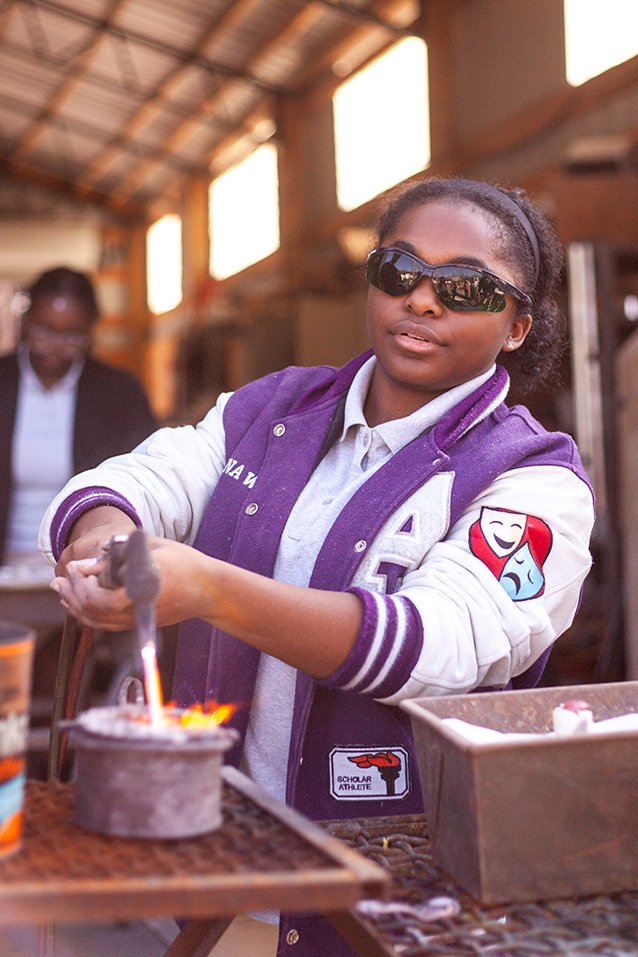
Our Eighth GradeExperience
Discover Bham
Every Friday afternoon, our 8th graders leave their desks to experience a taste of the perspective-expanding marvels that Birmingham has to offer. We’ve integrated trips to various local organizations, such as the Birmingham Museum of Art and Red Mountain Park, into their core curriculum.
Survey of Science
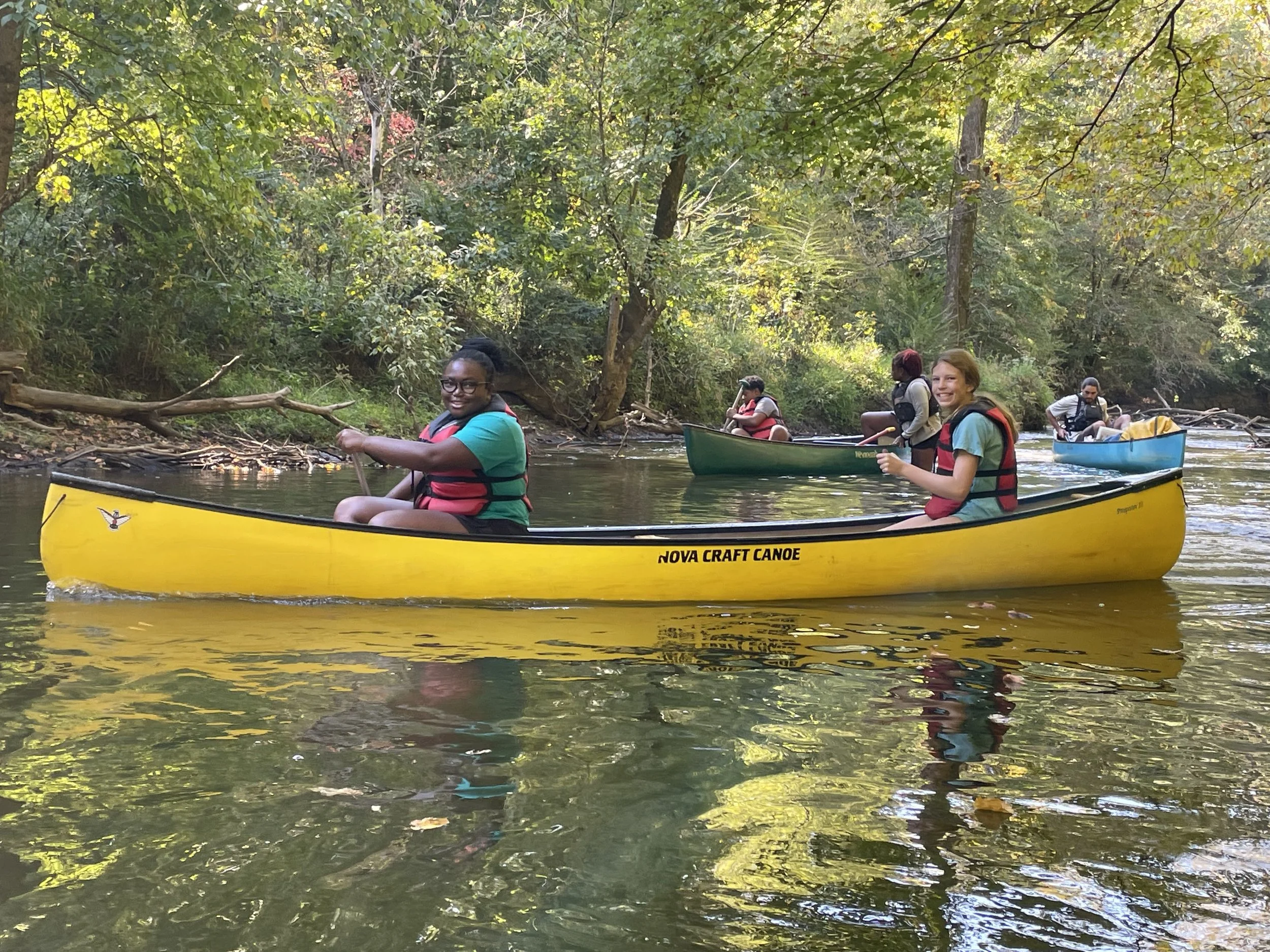
Eighth grade science students have the opportunity to take the knowledge they’ve learned in class and see it in action in an intellectually stimulating and curiosity-provoking environment. This includes kayaking among the dynamic wildlife at the Turkey Creek Nature Preserve, and observing the anatomy lab at the University of Alabama at Birmingham

Field Trips
Field trips continue to play a meaningful role in our Upper School curriculum and experience. Our oldest students are able to take advantage of resources and opportunities for study not only in our downtown neighborhood but in our broader state and regional area as well.
-
Camp McDowell Environmental Camp
Big Canoe Creek Nature Preserve
Carver Theatre / Alabama Jazz Hall of Fame
Alabama Shakespeare Festival -
Alabama Shakespeare Festival
Sloss Furnace
Dauphin Island Sea Lab
Cahaba Riverkeepers Canoe Trip -
Alabama Shakespeare Festival
High Ropes Course Adventure
Montgomery Legacy Museum
*Regular Friday trips through the 8th Grade Discover Bham program.